About 20 years ago I first heard a quote that the only way to truly know a person was to follow them home. I thought of Christ and how we can follow Him home and how much we learn about Him when we do. I thought of Temples being the houses of God and how much we learn about God and Christ by spending time in that home. Then I thought of visiting teaching. Visiting Teaching is an invitation to follow a sister home. You can learn things about a sister in her home that you could learn in no other way…not over the phone, not in the hall. In the Bible dictionary we learn that only the home compares with the Temple in sacredness. By entering a sister’s home we enter her most personal space…her world. Why do we choose not to go?
Why don’t we love visiting teaching? We don’t like to be told to be assigned to be a friend-or feeling like a friend had to be assigned to us, we don’t like another thing we have to do, we don’t enjoy reporting or feeling guilty…we’re busy, we’re shy, we forget, we’re distracted, we’re tired, we’re stressed. We’re too different from the people who’ve been assigned to, they’re doing fine anyway, they’re not doing fine and they wouldn’t want us there anyway, they’re busy themselves… We don’t always want to share the message. We forgot to read it, can’t find our Ensign, or don’t have an Ensign, we are having a good conversation anyway so why bother interrupting.
Last night in the Relief Society conference broadcast Sister Beck briefly connected statistic focused visiting teaching to the law of Moses. That really struck a chord with me. Do we ever look at Visiting teaching that way? As if it is a lesser law? I don’t know much about what was required by the law of Moses but I do know that it was there to point people to Christ. The animals sacrificed were unblemished, they were to be the best of the flock…it was all a reminder of Christ’s sacrifice for us. It’s not a very enjoyable reminder, but it would be very poignant. Killing animals isn’t the goal of the Law of Moses, a once a month visit isn’t the goal of visiting teaching.
When we visit teach because out of duty, because of stats, to get it done…we are only keeping the lesser law. That is not what visiting teaching requires of us. Making appointments, sharing a message…that is not what is required of us. The higher path of visiting teaching, the real goal? Zion.
Think of the sisters on your visiting teaching list, or think of sisters in the ward, choose one person, maybe they are sitting next to you…imagine that before that sister was born she had a personal interview with her Heavenly Father. Maybe he was excited about the family He was sending her to, maybe he was concerned because He knew well the situation she would be entering, maybe He was trying to prepare her for this life one last time. Maybe he gave her specific gifts that would help her in her specific situation. This sister is here now. She is most likely facing very real difficulties. She may have fears, challenges, and problems. She may have specific doubts that are part of the normal process of learning in the gospel, but are unsettling. All of us have times of weakness, fear, struggles. What does Heavenly Father want for this sister?
Homes are next to the temple in sacredness. When we enter the home of our sisters we learn so much about them
Visiting teacher consists of a message, service and reporting. Let’s look at what Jesus would do if He were here…what would he counsel Mary and Martha to do as visiting teachers?
First, the message. That standard gospel message you are asked to share every month carries truth, and it can bring in the spirit whether or not you feel it applies to this particular sister….OR you can pray and teach the sister what her Heavenly Father would have her know. Maybe that has nothing to do with the message, but I know that by studying the message you will be better prepared to teach this sister what God wants her to know. Russel M. Nelson taught in his April 2011 conference that no matter what fears we are struggling with…“We can combat those fears by strengthening our faith”. Sometimes we hesitate to share a message…it could feel awkward or forced, or perhaps we don’t know the sister well, or we know her too well. We ALL struggle at times with recognizing the spirit, and receiving revelation…do we know what our sisters are praying about? We can pray with them. By bringing the truth and the spirit into our visit, Heavenly Father can teach her whatever He needs her to know.
Eliza R. Snow said “A teacher…should surely have so much of the Spirit of the Lord, as she enters a house to know what spirit she meets in there…Plead before God and the Holy Ghost to get [the spirit] so that you will be able to meet that spirit that prevails in that house…and you may feel to talk word of peace and comfort, and if you find a sister feeling cold, take her to your heart as you would a child to your bosom and warm her up” How would our visiting teaching be if we weren’t just sharing a message, we were sharing truth? Some of us may not feel worthy or able to have that spirit with us so strongly. I have learned in callings that frequently the Lord blesses me far beyond my capacity because of His great love those I am serving. All He needs is my willingness...I have to BE there and want to do what He would have me do. While serving others the spirit is present to bless them and in the process it purifies me.
The second part of visiting teaching is service. The Lord wants us to love His daughter. He already loves her. He knows what is amazing and beautiful about her. He knows what gifts she has and what she needs to develop. He knows what help she needs. He has spent time with her. He hears all her prayers. He sees what she can become. How different would our visiting teaching if we saw our sister like God sees her? Sister Silvia Allred asked us to plead for charity, to “pray unto the Father with all the energy of heart, that ye may be filled with this love, which he hath bestowed upon all who are true followers of his Son Jesus Christ that ye may become the sons of God; that when he shall appear we shall be like him.”
President Kimball talked about visiting teaching and said “Your duties in many ways must be much like those of the [home] teachers, which briefly are to ‘watch over the church always’-not twenty minutes a month but always-‘and be with and strengthen them’-not a knock at the door, but to be with them, and lift them and strengthen them and empower them and fortify them”. Frequently what our sisters need most is a loving listening ear. We can be the visual reminder that God is listening when we listen to our sisters.
The Lord wants Zion. He wants us to truly care about the sisters…to love them and lead them gently back to Him. He wants our hearts knit together in love…they cannot be knit together if we never actually come into contact with them. Just like my daughter’s knitting over time small little acts and movements can make a beautiful creation. Loving and serving each other creates Zion..a people of “one heart of one mind and dwelt in righteousness and there was no poor among them.” Moses 7:18.
Reporting is the third part of visiting teaching…not because of the stats. Report because you love your sister and want others to best be able to help and love her. Report because you want the teachers and leaders to know how to direct our lessons and activities to best meet the needs of your sisters. Report what we can do to support you in your visiting teaching. There is no way for us to know how each individual sister is doing without help. A checkmark in a box does not help us know how the sister is doing.
It sounds amazing… since we all have hours of free time to devote to praying and learning the truths and the love that Heavenly Father would want for our sisters, extra time to spend in service and we always remember to call and report right? . I have presented an ideal. A beautiful, wonderful ideal. I have pointed to a mountain top far away and have tried to hopefully encourage us to what we can be. Last night Elder Uchtdorf reminded us to be patient with ourselves. Hopefully something of this message will inspire you. Hopefully you have felt the spirit. Listen to what it is inspiring you to be. Please be patient with yourself…but I hope you will be determined also.
The last few weeks my daughter has been trying to learn to serve a volleyball overhand. Her dad told her that she would fail and fail and fail and fail and fail..but she could learn from each failure and she would be getting closer to success. The failure is only the end if we stop trying…if we keep trying it is a part of our learning and success. She tried and tried…she’s easily served more than one hundred balls---most of them into or under the net. She let many many tosses drop because they were nowhere near where they needed to be-the ceiling or the other court…Yesterday she served a few balls over the net-in a game. She was so excited. I hope we can have her determination AND her ability to appreciate the beginning steps and successes.
Each attempt we make to visit teach strengthens our love for that sister. Every attempt to call or visit or prepare increases our abilities as a disciple of Christ. We may feel like it's a failure if we miss a month or she doesn't let us in, or we never seem to be able to get ahold of her. It may feel like we don't really understand her yet...but in the process we are developing the heart of a disciple.
Monday, September 26, 2011

Friday, August 20, 2010
noah-moses and empathy
We just moved so we are meeting many new people. Think of the last time you met someone new. How did that conversation go? I have noticed that frequently within two minutes of an introductory conversation it starts: the comparisons and judgements, the defensiveness and rationalizations. I’ll type a few facts about myself that come up in convercsation and see how if any of those kinds of thoughts come to your head: Hi my name is Britt. I have nine children, I homeschool, and I haven’t eaten sugar in almost seven years. Has it started yet? Are you questioning your family size, or mine? Are you defending your diet or the education of your children? Please don’t. PLEASE don’t. I’m not looking for an adversary, or a competitor. I need a friend.
When I tell people these basic facts about my life I hope they understand what I call the Noah-Moses principle. Moses should not have built Noah’s ark and neither should you. Join me in a thought exercise. Imagine Noah and Moses talking together. This is the first time they have met and they are likely discussing the miracles they are most famous for. Can you for one minute imagine them fighting over bragging rights for the best way to traverse impassible bodies of water? Can you imagine Moses leaving the conversation thinking about how he has never understood those boat-building types and wishing he had found someone more like him to talk with? It sounds cartoonish doesn’t it? Ridiculous and humorous, yet we do it all the time. We don’t wish we knew how to build a boat or part the seas…but we do wish for and question the missions and circumstances of others.
I first learned this concept a few years ago. At the time my twins were one. They were my sixth and seventh children. It had been a challenging year for our family. While our extended family was dealing with cancer, parkinsons, paralysis, open heart surgery and other major issues…we were dealing with sleep deprivation. Frequent and random interruptions of sleep are used to torture prisoners of war. The bring on weakness, helplessness, disillusionment and depression. Sleep deprivation is standard fair for parents of infants. About the time my twins turned one I went to a meeting with a group of women. A lovely lady was sharing her recent experiences with us. She had found her mission in life and in amazing ways she was changing the world. She and her daughter had gone to Africa on a three week adventure to help refugee children there. Her slides were stunning and inspiring. The need of the children was obvious. Her experiences led her to ask us in humility to help meet the specific needs of the children; we could go with her, or gather supplies or donate money. As she was speaking with all the passion and heart she could muster I felt a still small voice whisper…have another child. The voice did not tell me to go to Africa, though I would have loved it and there is much to do there. I was not told to fulfill her mission anymore than Moses was told to build an ark. The spirit saw through the beautiful details of the presentation to the principle..God loves you, God has a mission for you. You will be needed to do something amazing and impossible to bless his children.
Just like Moses and Noah, God may ask us to do something impossible. Fear can effect our ability to rely on the Lord to accomplish what He wants us to do. Fear may lead us to scurry about relying on the wisdom of women (even great ones). There is a definite logic that would lead us to NOT do what is so very obviously impossible. Lack of self worth may lead us to forget that God knows us and has a specific plan for us. It may not look dramatic or exciting. It may not be more or "better" or measurable at all. It may not be what we want to do at all. It will be God's plan for us. If Noah had built the Jaredite barges he would have been in trouble...the principle there wasn't even boat building. It was and always has been that the Lord prepares a way for us to accomplish all that he commands us. He does not help us accomplish what He has commanded other people to do.
Now what if the Jaredite barge builders, the Nephite boat builders, Noah and Moses all got together? Would Moses feel left out? We all like to be with people who have similar missions, similar circumstances and similar beliefs. It’s both motivating and comforting. Yet it doesn’t take specific circumstances or experiences to empathize..it takes a heart and listening ears. Or in other words, what I call the empathy principle… You don’t need to give birth in an elevator on Christmas eve to have empathy for others.
Two years ago I gave birth to a baby in an elevator. Dramatic, exciting, crazy! At first I hated to tell people about the birth because their reactions tended towards that extreme. I was the side show circus act fit for reality television. My feelings about the birth were far from those that would enjoy that voyeurism. I felt my body had betrayed me and endangered my baby. I felt such overwhelming fear and heartache surrounding the situation. I was in shock that I had gone through the experience. I had reoccurring nightmares as my mind tried to make sense of the birth. I felt very angry and very alone. I had many symptoms of post traumatic stress syndrome..from what some people saw as a dramatic, crazy and exciting experience-oh and SO easy to have such a short labor..how lucky.
I found a lot of understanding and healing from two fairly unlikely sources. Around that same time a friend had a homebirth. Unlike the peace and simplicity she had experienced surrounding some of her other births…this was an extremely long, difficult and painful birth I don’t remember all of the circumstances but I do know that what struck me was that we were feeling very similar feelings. She too felt betrayed by her body, a lot of anger and shock. She also felt misunderstood as she tried to explain her feelings to others. Our situations were fairly different, but I felt she understood me.
I also felt that Jesus understood me. I have always felt that jesus understands women even in our most female circumstances. He offers to the world life eternal and they refuse. He has been misunderstood and abused. Some people see him as weak and a sort of door mat. More appropriate to my current situation was the Atonement. I wondered at Jesus’ prayers in the Garden of Gethsemene and how his Apostles couldn’t wait with him one hour. I wonder if he worried that his body wouldn’t be able to do what he needed it to do. I know he asked to “let this cup pass from him”. I felt that Jesus understood me. In my dreams I slowly began to see angels surrounding my husband and I in that elevator. I can still feel that comfort.
The understanding and empathy I sought did not come from people who had experienced a Christmas Eve elevator birth…yes Christmas Eve. Isn’t that dramatic, exciting and crazy? Maybe reading this you have felt some empathy for me. You can share in my emotions even without sharing my experiences. Think of the most salient experiences in your life. They may involve pain, love, sorrow, loneliness, fear or helplessness. Those words probably don’t even begin to describe the depth of what you experienced. Those experiences can either separate us or unite us. We can choose to honestly say that no one else has ever really experienced exactly what we experienced, or we can open our hearts and recognize the emotions we feel in the hearts of others despite their wildly different circumstances.
The next time you meet someone I hope you remember the Noah-Moses principle and the Empathy principle. I hope it helps you develop a friendship where you might not have. I hope it helps you pursue your mission and encourage the efforts of others to do so. I hope if you meet me you will not focus on the differences that could separate us and instead take the time to make a friend.
When I tell people these basic facts about my life I hope they understand what I call the Noah-Moses principle. Moses should not have built Noah’s ark and neither should you. Join me in a thought exercise. Imagine Noah and Moses talking together. This is the first time they have met and they are likely discussing the miracles they are most famous for. Can you for one minute imagine them fighting over bragging rights for the best way to traverse impassible bodies of water? Can you imagine Moses leaving the conversation thinking about how he has never understood those boat-building types and wishing he had found someone more like him to talk with? It sounds cartoonish doesn’t it? Ridiculous and humorous, yet we do it all the time. We don’t wish we knew how to build a boat or part the seas…but we do wish for and question the missions and circumstances of others.
I first learned this concept a few years ago. At the time my twins were one. They were my sixth and seventh children. It had been a challenging year for our family. While our extended family was dealing with cancer, parkinsons, paralysis, open heart surgery and other major issues…we were dealing with sleep deprivation. Frequent and random interruptions of sleep are used to torture prisoners of war. The bring on weakness, helplessness, disillusionment and depression. Sleep deprivation is standard fair for parents of infants. About the time my twins turned one I went to a meeting with a group of women. A lovely lady was sharing her recent experiences with us. She had found her mission in life and in amazing ways she was changing the world. She and her daughter had gone to Africa on a three week adventure to help refugee children there. Her slides were stunning and inspiring. The need of the children was obvious. Her experiences led her to ask us in humility to help meet the specific needs of the children; we could go with her, or gather supplies or donate money. As she was speaking with all the passion and heart she could muster I felt a still small voice whisper…have another child. The voice did not tell me to go to Africa, though I would have loved it and there is much to do there. I was not told to fulfill her mission anymore than Moses was told to build an ark. The spirit saw through the beautiful details of the presentation to the principle..God loves you, God has a mission for you. You will be needed to do something amazing and impossible to bless his children.
Just like Moses and Noah, God may ask us to do something impossible. Fear can effect our ability to rely on the Lord to accomplish what He wants us to do. Fear may lead us to scurry about relying on the wisdom of women (even great ones). There is a definite logic that would lead us to NOT do what is so very obviously impossible. Lack of self worth may lead us to forget that God knows us and has a specific plan for us. It may not look dramatic or exciting. It may not be more or "better" or measurable at all. It may not be what we want to do at all. It will be God's plan for us. If Noah had built the Jaredite barges he would have been in trouble...the principle there wasn't even boat building. It was and always has been that the Lord prepares a way for us to accomplish all that he commands us. He does not help us accomplish what He has commanded other people to do.
Now what if the Jaredite barge builders, the Nephite boat builders, Noah and Moses all got together? Would Moses feel left out? We all like to be with people who have similar missions, similar circumstances and similar beliefs. It’s both motivating and comforting. Yet it doesn’t take specific circumstances or experiences to empathize..it takes a heart and listening ears. Or in other words, what I call the empathy principle… You don’t need to give birth in an elevator on Christmas eve to have empathy for others.
Two years ago I gave birth to a baby in an elevator. Dramatic, exciting, crazy! At first I hated to tell people about the birth because their reactions tended towards that extreme. I was the side show circus act fit for reality television. My feelings about the birth were far from those that would enjoy that voyeurism. I felt my body had betrayed me and endangered my baby. I felt such overwhelming fear and heartache surrounding the situation. I was in shock that I had gone through the experience. I had reoccurring nightmares as my mind tried to make sense of the birth. I felt very angry and very alone. I had many symptoms of post traumatic stress syndrome..from what some people saw as a dramatic, crazy and exciting experience-oh and SO easy to have such a short labor..how lucky.
I found a lot of understanding and healing from two fairly unlikely sources. Around that same time a friend had a homebirth. Unlike the peace and simplicity she had experienced surrounding some of her other births…this was an extremely long, difficult and painful birth I don’t remember all of the circumstances but I do know that what struck me was that we were feeling very similar feelings. She too felt betrayed by her body, a lot of anger and shock. She also felt misunderstood as she tried to explain her feelings to others. Our situations were fairly different, but I felt she understood me.
I also felt that Jesus understood me. I have always felt that jesus understands women even in our most female circumstances. He offers to the world life eternal and they refuse. He has been misunderstood and abused. Some people see him as weak and a sort of door mat. More appropriate to my current situation was the Atonement. I wondered at Jesus’ prayers in the Garden of Gethsemene and how his Apostles couldn’t wait with him one hour. I wonder if he worried that his body wouldn’t be able to do what he needed it to do. I know he asked to “let this cup pass from him”. I felt that Jesus understood me. In my dreams I slowly began to see angels surrounding my husband and I in that elevator. I can still feel that comfort.
The understanding and empathy I sought did not come from people who had experienced a Christmas Eve elevator birth…yes Christmas Eve. Isn’t that dramatic, exciting and crazy? Maybe reading this you have felt some empathy for me. You can share in my emotions even without sharing my experiences. Think of the most salient experiences in your life. They may involve pain, love, sorrow, loneliness, fear or helplessness. Those words probably don’t even begin to describe the depth of what you experienced. Those experiences can either separate us or unite us. We can choose to honestly say that no one else has ever really experienced exactly what we experienced, or we can open our hearts and recognize the emotions we feel in the hearts of others despite their wildly different circumstances.
The next time you meet someone I hope you remember the Noah-Moses principle and the Empathy principle. I hope it helps you develop a friendship where you might not have. I hope it helps you pursue your mission and encourage the efforts of others to do so. I hope if you meet me you will not focus on the differences that could separate us and instead take the time to make a friend.
Tuesday, January 5, 2010
bible in 90 days
A friend over at http://www.smockityfrocks.com/ suggested I read the Bible in 90 days. I think that's a little crazy. I've read the Bible before and it's long. I've already committed to join my older chidlren in reading the Book of Mormon in 90 days...yet here I am.
My thoughts form the frist few days of reading, which include most of Genesis, is that God loves us a lot. He loves us even if we are stupid, and if the book of Genesis is in anyway typical, we are REALLY stupid. It has been a comforting confirmation that Jesus is perfect and He is our Savior. His mercy is because of His goodness. The people in the OT surely made a slew of crazy decisions, yet God loved them. Perhaps He can love me despite my stupid decisions.
My thoughts form the frist few days of reading, which include most of Genesis, is that God loves us a lot. He loves us even if we are stupid, and if the book of Genesis is in anyway typical, we are REALLY stupid. It has been a comforting confirmation that Jesus is perfect and He is our Savior. His mercy is because of His goodness. The people in the OT surely made a slew of crazy decisions, yet God loved them. Perhaps He can love me despite my stupid decisions.
Tuesday, November 4, 2008
religious freedom
In the war of words that has become the prop 8 debate one troubling concept demands discussion. I'll leave the homosexual debate for another day, I'm talking about the first amendment. It reads "Congress shall make no law respecting an establishment of religion, or prohibiting the free exercise thereof; or abridging the freedom of speech, or of the press; or the right of the people peaceably to assemble, and to petition the Government for a redress of grievances."
Despite the constant barage and never ending repetition to the contrary...it is constitutional for me to vote based on my religious world view. The first amendment gaurantees that right. Common sense supports that right.
All laws are moral in their basis. ALL laws are moral in their basis. We all vote depending on what we feel is right or wrong, what is of greater or lesser value.
To categorically say that a group of people who believe the Bible cannot vote based on morals they have developed related to that belief is fallacy. A vote is expressing one's opinion, not forcing it upon other. A vote from a religious world view is no more force than a vote from any other point of view. We can develop our morals however we want, then vote as we desire based on those morals.
If we are to say morals based on the Bible are somehow not appropriate, it begs the question what books are appropriate to base your morals on then? Ayn Rand is okay? Stalin okay? Anything in favor of God..not so much? We can read books by political pundits, but not anything religious? Or is it just certain religions that are singled out? Who chooses this? Popular opinion?
Perhaps it is the number of people believing in a certain book...so if a certain percentage of the population read and votes based on Obama's books would they also be forcing their views with their votes?
Which beliefs are forced and which are inappropriate even in the Bible? The Bible teaches pretty strongly against murder. Shall I vote against that or is that also forcing my beliefs on others? How about child abuse? Am I allowed to vote against one moral issue, but not another and how is that decided and who is it decided by? You?
It becomes clear that I am only allowed to vote based on my religious world view when it agrees with the "general public" . Now by general public I do not mean the majority of the population that actually has religious faith, but the minority of the population that does not! On a more personal level, if the person I am speaking with disagrees with my moral stance on any law *I* am forcing my religion on them. Are they forcing their lack of religion on me? Or is this a one way purely anti religion tact? Are my morals of lesser consideration because my religion has influenced their development? Is this decided on a case by case basis?
How about religious people who vote differently from me? Are they forcing their views on me? If they vote similarly to you is it still wrong for them to vote based on their religious world view?
I am clear that I should not vote my religious practices into law. I do not think anyone should be forced to believe anything..if that were even possible. I do not think either that specific practices, such as requiring certain clothes, reading certain books or praying a certain way should be legislated. That is what the first amendment is all about. The government allows people to practice their religion or lack there of, but does not enforce any certain manner of religious practice.
But religion is not solely practices. Religion is not a checklist of beliefs that I consult, or a list of doctrines I memorize. It is not a set of counsel that I am to follow. The counsel to vote in void without my religion is implying I could. I cannot. My beliefs are intrinsically a part of me. Religion effects what I eat, where I live, what kind of job I seek, what kind of books I read, how I see the world. I cannot leave my world view at the door. Can you? Can you somehow leave everything you have experienced and felt and lived at the door of the voting booth in some sort of blank slate phenomena? If I could leave my world view at the door, what would be the cost? Would I also be leaving everything that is compassionate, giving and serving at the door as well as my sometimes troublesome morals?
The constitution demands that we value the votes of all. Those who believe as we do, those who disagree, those who are young or old, male or female, black or white...we all have unique life experiences, different morals and different political opinions. That is one of the reasons why this nation is so amazing. We all have a voice.
Despite the constant barage and never ending repetition to the contrary...it is constitutional for me to vote based on my religious world view. The first amendment gaurantees that right. Common sense supports that right.
All laws are moral in their basis. ALL laws are moral in their basis. We all vote depending on what we feel is right or wrong, what is of greater or lesser value.
To categorically say that a group of people who believe the Bible cannot vote based on morals they have developed related to that belief is fallacy. A vote is expressing one's opinion, not forcing it upon other. A vote from a religious world view is no more force than a vote from any other point of view. We can develop our morals however we want, then vote as we desire based on those morals.
If we are to say morals based on the Bible are somehow not appropriate, it begs the question what books are appropriate to base your morals on then? Ayn Rand is okay? Stalin okay? Anything in favor of God..not so much? We can read books by political pundits, but not anything religious? Or is it just certain religions that are singled out? Who chooses this? Popular opinion?
Perhaps it is the number of people believing in a certain book...so if a certain percentage of the population read and votes based on Obama's books would they also be forcing their views with their votes?
Which beliefs are forced and which are inappropriate even in the Bible? The Bible teaches pretty strongly against murder. Shall I vote against that or is that also forcing my beliefs on others? How about child abuse? Am I allowed to vote against one moral issue, but not another and how is that decided and who is it decided by? You?
It becomes clear that I am only allowed to vote based on my religious world view when it agrees with the "general public" . Now by general public I do not mean the majority of the population that actually has religious faith, but the minority of the population that does not! On a more personal level, if the person I am speaking with disagrees with my moral stance on any law *I* am forcing my religion on them. Are they forcing their lack of religion on me? Or is this a one way purely anti religion tact? Are my morals of lesser consideration because my religion has influenced their development? Is this decided on a case by case basis?
How about religious people who vote differently from me? Are they forcing their views on me? If they vote similarly to you is it still wrong for them to vote based on their religious world view?
I am clear that I should not vote my religious practices into law. I do not think anyone should be forced to believe anything..if that were even possible. I do not think either that specific practices, such as requiring certain clothes, reading certain books or praying a certain way should be legislated. That is what the first amendment is all about. The government allows people to practice their religion or lack there of, but does not enforce any certain manner of religious practice.
But religion is not solely practices. Religion is not a checklist of beliefs that I consult, or a list of doctrines I memorize. It is not a set of counsel that I am to follow. The counsel to vote in void without my religion is implying I could. I cannot. My beliefs are intrinsically a part of me. Religion effects what I eat, where I live, what kind of job I seek, what kind of books I read, how I see the world. I cannot leave my world view at the door. Can you? Can you somehow leave everything you have experienced and felt and lived at the door of the voting booth in some sort of blank slate phenomena? If I could leave my world view at the door, what would be the cost? Would I also be leaving everything that is compassionate, giving and serving at the door as well as my sometimes troublesome morals?
The constitution demands that we value the votes of all. Those who believe as we do, those who disagree, those who are young or old, male or female, black or white...we all have unique life experiences, different morals and different political opinions. That is one of the reasons why this nation is so amazing. We all have a voice.
Sunday, October 19, 2008
I am susan
My darling little three year olds were walking down the hallway wrapped in their towels. They had that fresh smell and clean faces. They also had somehow snuck a dolly in the bath and each of them had dipped their towels back in the water.
I checked on my husband's progress in the flood control and then came out to dress the girls. I heard the following argument. "You are soaking wet!" said Kalani. "No I'm not, I'm SUSAN!"
This same interchange continued probably a dozen or so times before I could pull Susan away and encourage Kalani to not belabor the point.
Although I've heard similar arguments in the past with other children, for some reason this time it struck me. We frequently forget who we really are and instead identify ourselves by our current circumstances. Are we a student, Stay at home mom, teacher, accountant, musician? Are we fat, poor, messy, well dressed or depressed?
Are we identifying ourselves or those around us by something temporary, or lasting? Are we seeing what people wear or who they are?
I checked on my husband's progress in the flood control and then came out to dress the girls. I heard the following argument. "You are soaking wet!" said Kalani. "No I'm not, I'm SUSAN!"
This same interchange continued probably a dozen or so times before I could pull Susan away and encourage Kalani to not belabor the point.
Although I've heard similar arguments in the past with other children, for some reason this time it struck me. We frequently forget who we really are and instead identify ourselves by our current circumstances. Are we a student, Stay at home mom, teacher, accountant, musician? Are we fat, poor, messy, well dressed or depressed?
Are we identifying ourselves or those around us by something temporary, or lasting? Are we seeing what people wear or who they are?
Monday, October 13, 2008
The poverty of motherhood
We are puppy sitting. Some friends are be out of town for a week and we have their 8 week old puppies. We have Tigger, Freckles and Snoopy. Tigger and Freckles are brothers. They are very snuggly and playful; everything you could want in a puppy. Snoopy is fun and playful, but a little wary. He is sometimes extremely defensive of the food bowl and is snappy when you move towards him with an open hand that isn't palm up. Snoopy hasn't been treated well. We don't know the details, but the owners were warned of this when they got him and the behavior difference between the dogs is stark at times.
When I heard today was blog action day, with the focus on Poverty, Snoopy was the first thing that came to mind. I know a few children that are like Snoopy. Poverty isn't solely a lack of money, sometimes it is a poverty of love, a poverty of motherhood. Babies who have not had their basic needs met, food, diapering and a little love, can develop a disorder called reactive attachment disorder. Motherhood is so amazingly powerful a DISORDER will develop if it isn't done at even a basic level. It may manifest itself in a variety of ways at first. The baby may be stiff, not cuddly. Lack of eye contact is a typical sign, but hard to detect in a newborn or excitable toddler. Sometimes the baby won't cry even when hungry, because she has learned it doesn't work, nobody comes. Sometimes the baby sleeps a lot and is listless, because she doesn't have the energy for much else and doesn't have coping mechanisms for how to take care of herself.
I have met some darling adopted babies who started out life not having their needs met. Some babies were left with a few bottles in playpens, not having a diaper changed or being looked on for days at a a time. Mom has friends over and is busy with drugs and a new guy. Some were left in a swing or high chair for long periods of time while mom left the house. All too frequently the real cause is the stress and overwelm of poverty. Though love doesn't cost anything, it requires time, hope, patience and a gentleness that are increasingly difficult when the mother is literally starving and sees no future for herself.
A baby who sleeps a lot and seldom cries sounds eerily nice. Even if suddenly the needs start being met some children will have lifelong issues to face from this early situation. The child is still a child and in trying to be self reliant, rejects anyone attempting to take over that role of caregiver. It's a form of emotional self preservation. The child has been taught that no one will help her meet her basic needs. Something in their little hearts has broken, as if they no longer have the ability to love or trust or accept even the most basic of necessities. The consequences shift from a lack of crying, a stiffness and listlessness, to a failure to make eye contact, a refusal to accept affection and an undercurrent of violence.
It's unthinkable really. The future of our nation, our most precious resource, unattended and uncared for. This results in a baby who is callous or a child who is a time bomb and may begin his show of rage at anyone who dares to come into his life and claim the title mother. Make no mistake this rage will generalize towards others and as the child gets stronger, their power to destroy increases. The price to be paid by society will be not only the loss of the distinct character and gift of that child, but a whirlwind of damage and loss as the growing child turns to drug use or increasing acts of violence to push people away.
It is staggering to think that the simple act of holding and feeding a baby has dramatic effects. We know that brain development occurs when a mother holds and feeds her baby. http://www.cdc.gov/ncbddd/child/ and http://www.nlm.nih.gov/medlineplus/news/fullstory_67965.html We need to rethink the rocking chair. The simple task of holding a baby has long term effects for the baby and society. Changing a diaper and comforting a baby are both critically important tasks. Does that seem dramatic? Perhaps, but it is true.
Feeding a baby helps connect neurons in the brain! I have seen effects of a poverty of motherhood in the lives of children. It is difficult to imagine. It is hard to understand the feelings some foster parents face as they try to care for children who haven't experienced enough caring before. Despite years of love and attention, a young person damaged by the initial years of neglect may still reject the woman who has dared to be mother. It is much easier to keep a child's heart than to reclaim it.
We are in many respects experiencing a poverty of motherhood in America. It is not always as drastic as in attachment disorder children. Sometimes it is as simple as working mothers, teenage mothers, or single mothers. It is absolutely true that some people in these categories did not choose them and are working desparately to be everything to their children. A mother can do amazing things and stay involved in her children's lives even if circumstances and time are not ideal. However, the underlying theme running through these situations is a fundamental misunderstanding of the value of motherhood in the life of the child. Sometimes a mother must work and children can understand when it is a necessity, but they know the difference. Chidlren know when something is being chosen over them, whether it is nicer clothes, personal fulfillment or financial gain.
It is not just nice for a child to have a mother, it is essential for their emotional and physical growth. Children need a great quantity of time so when they are ready the quality moments can happen, not in little packages of time on the adults schedule, but casually by the kitchen sink, or sorting the laundry, reading a book or sweeping the floor. The basic development of a child is only possible when a mother chooses to mother. It cannot be outsourced for convenience sake, it cannot be begun too early by mistake. The development of a healthy child demand preparation and attention.
It is really astounding that it would ever have to be said that a woman should mother her children. She should choose when to have those children thoughtfully, then devote herself to them. Time in the rocking chair should be encouraged, supported and recognized for what it is, a powerful life giving force. Motherhood can reduce poverty and increase peace in the world on small and grand scales.
In saying all of this I do not mean to under emphasize the power of fatherhood, just to delegate another day for a discussion of that role.
Now back to our dear little friend snoopy. We have hopes for him as his owners have already seen great progress. We are very patient and he is coming along. His owners may have to resort at times to physically controlling him and caging him. As a young child I had a dog like snoopy who had been mistreated. We ended up putting him to sleep because despite all our efforts he bit everyone and was only increasing in his violence. Rightly, we would never consider physically controlling or "putting to sleep" an increasingly violent child. Children are too precious and valuable, no matter their behavior.
It's time we recognize chidlren as a priority in a practical, simple way. The path to destroy the poverty of motherhood is a simple one. It involves singing to your child no matter your voice, playing a game, rocking and reading more, encouraging a young mother, reminding a teen of her own self worth and her potential for motherhood and a thousand other little ways in which can affirm that motherhood matters. Tell the next young mother you see that what they do is powerful. It is not simply a rite of passage for a young woman it is a fundamental, saving power in our society. "For the hand that rocks the cradle is the hand that rules the world." William Stewart Ross "Woman:her glory, her shame, her God"
When I heard today was blog action day, with the focus on Poverty, Snoopy was the first thing that came to mind. I know a few children that are like Snoopy. Poverty isn't solely a lack of money, sometimes it is a poverty of love, a poverty of motherhood. Babies who have not had their basic needs met, food, diapering and a little love, can develop a disorder called reactive attachment disorder. Motherhood is so amazingly powerful a DISORDER will develop if it isn't done at even a basic level. It may manifest itself in a variety of ways at first. The baby may be stiff, not cuddly. Lack of eye contact is a typical sign, but hard to detect in a newborn or excitable toddler. Sometimes the baby won't cry even when hungry, because she has learned it doesn't work, nobody comes. Sometimes the baby sleeps a lot and is listless, because she doesn't have the energy for much else and doesn't have coping mechanisms for how to take care of herself.
I have met some darling adopted babies who started out life not having their needs met. Some babies were left with a few bottles in playpens, not having a diaper changed or being looked on for days at a a time. Mom has friends over and is busy with drugs and a new guy. Some were left in a swing or high chair for long periods of time while mom left the house. All too frequently the real cause is the stress and overwelm of poverty. Though love doesn't cost anything, it requires time, hope, patience and a gentleness that are increasingly difficult when the mother is literally starving and sees no future for herself.
A baby who sleeps a lot and seldom cries sounds eerily nice. Even if suddenly the needs start being met some children will have lifelong issues to face from this early situation. The child is still a child and in trying to be self reliant, rejects anyone attempting to take over that role of caregiver. It's a form of emotional self preservation. The child has been taught that no one will help her meet her basic needs. Something in their little hearts has broken, as if they no longer have the ability to love or trust or accept even the most basic of necessities. The consequences shift from a lack of crying, a stiffness and listlessness, to a failure to make eye contact, a refusal to accept affection and an undercurrent of violence.
It's unthinkable really. The future of our nation, our most precious resource, unattended and uncared for. This results in a baby who is callous or a child who is a time bomb and may begin his show of rage at anyone who dares to come into his life and claim the title mother. Make no mistake this rage will generalize towards others and as the child gets stronger, their power to destroy increases. The price to be paid by society will be not only the loss of the distinct character and gift of that child, but a whirlwind of damage and loss as the growing child turns to drug use or increasing acts of violence to push people away.
It is staggering to think that the simple act of holding and feeding a baby has dramatic effects. We know that brain development occurs when a mother holds and feeds her baby. http://www.cdc.gov/ncbddd/child/ and http://www.nlm.nih.gov/medlineplus/news/fullstory_67965.html We need to rethink the rocking chair. The simple task of holding a baby has long term effects for the baby and society. Changing a diaper and comforting a baby are both critically important tasks. Does that seem dramatic? Perhaps, but it is true.
Feeding a baby helps connect neurons in the brain! I have seen effects of a poverty of motherhood in the lives of children. It is difficult to imagine. It is hard to understand the feelings some foster parents face as they try to care for children who haven't experienced enough caring before. Despite years of love and attention, a young person damaged by the initial years of neglect may still reject the woman who has dared to be mother. It is much easier to keep a child's heart than to reclaim it.
We are in many respects experiencing a poverty of motherhood in America. It is not always as drastic as in attachment disorder children. Sometimes it is as simple as working mothers, teenage mothers, or single mothers. It is absolutely true that some people in these categories did not choose them and are working desparately to be everything to their children. A mother can do amazing things and stay involved in her children's lives even if circumstances and time are not ideal. However, the underlying theme running through these situations is a fundamental misunderstanding of the value of motherhood in the life of the child. Sometimes a mother must work and children can understand when it is a necessity, but they know the difference. Chidlren know when something is being chosen over them, whether it is nicer clothes, personal fulfillment or financial gain.
It is not just nice for a child to have a mother, it is essential for their emotional and physical growth. Children need a great quantity of time so when they are ready the quality moments can happen, not in little packages of time on the adults schedule, but casually by the kitchen sink, or sorting the laundry, reading a book or sweeping the floor. The basic development of a child is only possible when a mother chooses to mother. It cannot be outsourced for convenience sake, it cannot be begun too early by mistake. The development of a healthy child demand preparation and attention.
It is really astounding that it would ever have to be said that a woman should mother her children. She should choose when to have those children thoughtfully, then devote herself to them. Time in the rocking chair should be encouraged, supported and recognized for what it is, a powerful life giving force. Motherhood can reduce poverty and increase peace in the world on small and grand scales.
In saying all of this I do not mean to under emphasize the power of fatherhood, just to delegate another day for a discussion of that role.
Now back to our dear little friend snoopy. We have hopes for him as his owners have already seen great progress. We are very patient and he is coming along. His owners may have to resort at times to physically controlling him and caging him. As a young child I had a dog like snoopy who had been mistreated. We ended up putting him to sleep because despite all our efforts he bit everyone and was only increasing in his violence. Rightly, we would never consider physically controlling or "putting to sleep" an increasingly violent child. Children are too precious and valuable, no matter their behavior.
It's time we recognize chidlren as a priority in a practical, simple way. The path to destroy the poverty of motherhood is a simple one. It involves singing to your child no matter your voice, playing a game, rocking and reading more, encouraging a young mother, reminding a teen of her own self worth and her potential for motherhood and a thousand other little ways in which can affirm that motherhood matters. Tell the next young mother you see that what they do is powerful. It is not simply a rite of passage for a young woman it is a fundamental, saving power in our society. "For the hand that rocks the cradle is the hand that rules the world." William Stewart Ross "Woman:her glory, her shame, her God"
Sunday, September 28, 2008
I thought I was done with third wave last week...darn thing isn't done with me. It occurs to me that there are probably dozens of lessons to be learned from that "backwards" agricultural age. There is aconcept as basic as gravity. As well known and commonly accepted...yet somehow we have lost the meaning of it in application. It is the law of the harvest. As the spiritual sings, you are going to reap what you sew.
This is the law of natural consequences. When you sew wheat, you harvest wheat...countless generations relied on this basic unquestionable law. Then along came toffler's second wave. We moved away from farms and their natural laws which technology seemed to overide. Technology and medicine sometimes strive to remove or mask consequences. Yet we haven't escaped the law of the harvest. Overeating, credit card debt, immorality and laziness all betray a generation that does not understand the law of the harvest. Every action we take has a consequence. Technology can delay that consequence or shuffle it around, but it cannot remove it. We are reaping a whirlwind of consequences. A majority of children don't live with their biological father and mother. Many people spend more than they earn. People eat more than their bodies need...including things that are known to be harmful. People spend their money on get rich quick schemes, ponzis flourish, lotteries expand and few profit.
Our ancestors would be perplexed if they could watch us continue in unhealthy patterns. How rediculous it would seem to them that with so much variety of food available to us, we still manage to be malnourished. Why, they would wonder, do we buy what we don't need and can't afford? Why should we ignore our spiritual feelings, but jump and run at the slightest physical attraction?
Perhaps the question we should ask is how can we use technology without loosing sight of natural laws?
This is the law of natural consequences. When you sew wheat, you harvest wheat...countless generations relied on this basic unquestionable law. Then along came toffler's second wave. We moved away from farms and their natural laws which technology seemed to overide. Technology and medicine sometimes strive to remove or mask consequences. Yet we haven't escaped the law of the harvest. Overeating, credit card debt, immorality and laziness all betray a generation that does not understand the law of the harvest. Every action we take has a consequence. Technology can delay that consequence or shuffle it around, but it cannot remove it. We are reaping a whirlwind of consequences. A majority of children don't live with their biological father and mother. Many people spend more than they earn. People eat more than their bodies need...including things that are known to be harmful. People spend their money on get rich quick schemes, ponzis flourish, lotteries expand and few profit.
Our ancestors would be perplexed if they could watch us continue in unhealthy patterns. How rediculous it would seem to them that with so much variety of food available to us, we still manage to be malnourished. Why, they would wonder, do we buy what we don't need and can't afford? Why should we ignore our spiritual feelings, but jump and run at the slightest physical attraction?
Perhaps the question we should ask is how can we use technology without loosing sight of natural laws?
Wednesday, September 24, 2008
3rd Wave
I recently finished an intriguing book called Third Wave by Alvin Toffler. He details three distinct "Waves" in history. The first is agricultural, the second is industrial..then there is now.
He details the huge changes between the first two waves and talks about how we can use those to anticipate the changes of the future. In discussing the changes between the first two waves he identifies one main force in the changes; the division of production and consumption. In the first wave extended family lived together. The home was the heart of society. Marriage was largely a practical concept...with marriage partners looking for survival skills and health, or in the upper classes aliances. A majority of what was produced by the family unit stayed and supported the family. Time was measured cyclically with the seasons. Education was hard work and primarily at home or with tutors or small groups. Trade was the most common market function.
Then came the second wave. The factory is the primary symbol of the second wave. Mass production separated production and consumption. There was a need for a marketplace-intermediary people. Work was predominantly away from home and with the growing marketplace, and need for intermediaries and management, more people were separated from actual production. Success was measurable and focused on the bottom line. The nuclear family became the norm, with a father, mother and children moving to where the work was and away from their extended family. Public schools took children away from home, and with less property to manage a woman's role was further dimished. Marraige became focused on attraction and romantic love. Time was measured linearly, with progress the goal. Education became preparation for work and schools bear an intentional likeness to the factory with promptness and assimilation being taught alongside reading and writing.
In the third wave Toffler anticipates a Prosumer...people working from home and reclaiming responsibility for their education and production.
What fascinated me most of this discussion was the role of woman. In the first wave a woman worked beside her husband and performed a valuable and necessary role in society. Her role as both producer (in her homemaking) and consumer were prominent and critical for family survival. Her role as mother fit in with this concept of extended family, cyclical time philosophy and the home as the center of society. As the second wave rolled through man's role as provider was drastically changed. He was pulled from the home and separated from most creative production. he was a part of a huge factory machine. Man was in the marketplace though...he had advanced, while generally women remained home. Women stayed in their first wave role and as mothers their lives were more cyclical than linear. They had not "progressed". Suddenly motherhood could be considered a backward function and as it was unmeasurable and out of the market. Public schools took over mother's role as teacher, hospitals-her role as healer, and mass production her role as family seamstress and food production. Stay at home motherhood was effectively outsourced, and motherhood could be considered as backward as those communities who maintain their agricultural age.
Alvin Toffler theorizes that the third wave will revolutionize every aspect of life as drastically as the change between the first two waves. Ecological concerns and energy limitations will demand balance from the marketplace. He quickly passes over changes in the family including a changed concept of marriage. Marriage will become practical and romantic, with a greater variety of types and styles.
Toffler glosses over this and moves on with his focus on world economy. I stopped in my tracks. If such long lasting changes have come form the first to second wave as we directly attacked the man's role as a provider and separated production from consumption...what will happen as we attack the roles of mother and father? Science already makes childbearing without natural conception possible. Adoption and In Vitro Fertilization separate mother and child...sometimes this separation is for infertility, unprepared pregnancy or homosexual parents desiring children. What long lasting effects are there from this fundamental division of motherhood's role? For the father and the mother Toffler predicts greater freedom...but what is the consequence for the child?
Toffler identified a cry for meaning in the industrial age. Greater responsibility in production and consumption do not produce meaning. Reduced social morals do not produce meaning. I value progress. I value science and advancement. I wonder what if the amazing changes of the second and third waves were tempered and framed within the principle that family matters. Fatherhood is critically important. Motherhood is immeasurably valuable. Children are the future. The nurturing, education and raising of future leaders can never be outsourced, mass produced or even randomly made according to whatever feels good and happens to be convenient. Ethical development must outpace and guide all other aspects of human development.
The third wave can be an opportunity to truthfully guide technology and progress towards a gentler society. The stability required for the changes coming in the third wave is to be found in strong homes. The unity possible by information technology must be a natural outpouring from unified families.
He details the huge changes between the first two waves and talks about how we can use those to anticipate the changes of the future. In discussing the changes between the first two waves he identifies one main force in the changes; the division of production and consumption. In the first wave extended family lived together. The home was the heart of society. Marriage was largely a practical concept...with marriage partners looking for survival skills and health, or in the upper classes aliances. A majority of what was produced by the family unit stayed and supported the family. Time was measured cyclically with the seasons. Education was hard work and primarily at home or with tutors or small groups. Trade was the most common market function.
Then came the second wave. The factory is the primary symbol of the second wave. Mass production separated production and consumption. There was a need for a marketplace-intermediary people. Work was predominantly away from home and with the growing marketplace, and need for intermediaries and management, more people were separated from actual production. Success was measurable and focused on the bottom line. The nuclear family became the norm, with a father, mother and children moving to where the work was and away from their extended family. Public schools took children away from home, and with less property to manage a woman's role was further dimished. Marraige became focused on attraction and romantic love. Time was measured linearly, with progress the goal. Education became preparation for work and schools bear an intentional likeness to the factory with promptness and assimilation being taught alongside reading and writing.
In the third wave Toffler anticipates a Prosumer...people working from home and reclaiming responsibility for their education and production.
What fascinated me most of this discussion was the role of woman. In the first wave a woman worked beside her husband and performed a valuable and necessary role in society. Her role as both producer (in her homemaking) and consumer were prominent and critical for family survival. Her role as mother fit in with this concept of extended family, cyclical time philosophy and the home as the center of society. As the second wave rolled through man's role as provider was drastically changed. He was pulled from the home and separated from most creative production. he was a part of a huge factory machine. Man was in the marketplace though...he had advanced, while generally women remained home. Women stayed in their first wave role and as mothers their lives were more cyclical than linear. They had not "progressed". Suddenly motherhood could be considered a backward function and as it was unmeasurable and out of the market. Public schools took over mother's role as teacher, hospitals-her role as healer, and mass production her role as family seamstress and food production. Stay at home motherhood was effectively outsourced, and motherhood could be considered as backward as those communities who maintain their agricultural age.
Alvin Toffler theorizes that the third wave will revolutionize every aspect of life as drastically as the change between the first two waves. Ecological concerns and energy limitations will demand balance from the marketplace. He quickly passes over changes in the family including a changed concept of marriage. Marriage will become practical and romantic, with a greater variety of types and styles.
Toffler glosses over this and moves on with his focus on world economy. I stopped in my tracks. If such long lasting changes have come form the first to second wave as we directly attacked the man's role as a provider and separated production from consumption...what will happen as we attack the roles of mother and father? Science already makes childbearing without natural conception possible. Adoption and In Vitro Fertilization separate mother and child...sometimes this separation is for infertility, unprepared pregnancy or homosexual parents desiring children. What long lasting effects are there from this fundamental division of motherhood's role? For the father and the mother Toffler predicts greater freedom...but what is the consequence for the child?
Toffler identified a cry for meaning in the industrial age. Greater responsibility in production and consumption do not produce meaning. Reduced social morals do not produce meaning. I value progress. I value science and advancement. I wonder what if the amazing changes of the second and third waves were tempered and framed within the principle that family matters. Fatherhood is critically important. Motherhood is immeasurably valuable. Children are the future. The nurturing, education and raising of future leaders can never be outsourced, mass produced or even randomly made according to whatever feels good and happens to be convenient. Ethical development must outpace and guide all other aspects of human development.
The third wave can be an opportunity to truthfully guide technology and progress towards a gentler society. The stability required for the changes coming in the third wave is to be found in strong homes. The unity possible by information technology must be a natural outpouring from unified families.
Saturday, August 30, 2008
anger management
The more children I've had I've discovered I'm a far better student and volleyball player than I am a mother. I prefer controlled environments..at least to practice in until I'm ready! Children don't exactly offer that! They don't wait to grow up while you figure things out.
For years I have tried to completely change my way of speaking with my children. Sometimes I yell and almost always it is because I am tired or hungry! I have tried all sorts of things...studied many different ideas. One of the most humbling was when I asked my children to say a prayer for me when I knew I was loosing it.
This past summer has been ... unexplainable. Chris' dad died, we moved, lived with his mother for a while, then moved again to Texas. The emotions and stress don't seem to be explained in those few words.
During this time a wonderful friend started a book group. We read Corrie Ten Boom and Ghandi and Mother Teresa...each inspiring me to turn to the scriptures again (which during this time of transition has been a challenge). It was Ghandi who made the most obvious impact. Despite all of my studying and pondering and prayer, I still thought yelling worked. Technically it does, in the short term. Children move when I am angry. I was wrong. Yelling doesn't work. it doesn't really do what I want it to do. It offers short term results but doesn't offer the environment for my children to truly change their hearts and want to do what is right.
For one thing violence is not specific! We are angry because we are hungry, tired, frustrated with all number of things...so when I get angry with my children how do they know what is behind my anger...Angry acts through history show this so clearly. We wonder and question why so and so did such horrible things...but Rosa Parks? No one wonders why she wouldn't leave her seat. Her meaning is PERFECTLY clear!
One poignant episode from Ghandi's life is so creative and masterful...yet so simple. He walked for 24 days, 12 miles a day. He dipped in the ocean and picked up a pinch of salt...he had just broken the law! It was a gainst the law at that time to acquire salt in any other way except through the huge British Salt company. His protest was so simple and clear-not a drop of confusion. Had he bombed a salt mine people could wonder if it was the owner of the mine, the location, the product, the country, perhaps he was hungry and tired...anger isn't specific enough to make a difference!
For whatever reason all of this reading and this summer has brought a dramatic change in my parenting. I'm still not getting the dishes done every single night -- our schedules still need some adjusting -- please don't ask about the laundry or much of anything else...instead for the first time I am basing my parenting on a truth...peace and love are the ONLY things that allow for the growth and change I want for my children.
My children are still completely human, as am I. Whiny voices, tantrums, and fighting occur...but I am now being an adult and learning to be a peacemaker.
For years I have tried to completely change my way of speaking with my children. Sometimes I yell and almost always it is because I am tired or hungry! I have tried all sorts of things...studied many different ideas. One of the most humbling was when I asked my children to say a prayer for me when I knew I was loosing it.
This past summer has been ... unexplainable. Chris' dad died, we moved, lived with his mother for a while, then moved again to Texas. The emotions and stress don't seem to be explained in those few words.
During this time a wonderful friend started a book group. We read Corrie Ten Boom and Ghandi and Mother Teresa...each inspiring me to turn to the scriptures again (which during this time of transition has been a challenge). It was Ghandi who made the most obvious impact. Despite all of my studying and pondering and prayer, I still thought yelling worked. Technically it does, in the short term. Children move when I am angry. I was wrong. Yelling doesn't work. it doesn't really do what I want it to do. It offers short term results but doesn't offer the environment for my children to truly change their hearts and want to do what is right.
For one thing violence is not specific! We are angry because we are hungry, tired, frustrated with all number of things...so when I get angry with my children how do they know what is behind my anger...Angry acts through history show this so clearly. We wonder and question why so and so did such horrible things...but Rosa Parks? No one wonders why she wouldn't leave her seat. Her meaning is PERFECTLY clear!
One poignant episode from Ghandi's life is so creative and masterful...yet so simple. He walked for 24 days, 12 miles a day. He dipped in the ocean and picked up a pinch of salt...he had just broken the law! It was a gainst the law at that time to acquire salt in any other way except through the huge British Salt company. His protest was so simple and clear-not a drop of confusion. Had he bombed a salt mine people could wonder if it was the owner of the mine, the location, the product, the country, perhaps he was hungry and tired...anger isn't specific enough to make a difference!
For whatever reason all of this reading and this summer has brought a dramatic change in my parenting. I'm still not getting the dishes done every single night -- our schedules still need some adjusting -- please don't ask about the laundry or much of anything else...instead for the first time I am basing my parenting on a truth...peace and love are the ONLY things that allow for the growth and change I want for my children.
My children are still completely human, as am I. Whiny voices, tantrums, and fighting occur...but I am now being an adult and learning to be a peacemaker.
Wednesday, May 7, 2008


Sunday, February 17, 2008
snow and sun
The other day I was shoveling our driveway. We have had extra helpings of snow this winter and we haven't kept up with snow removal. Under the layer of freshly fallen snow was a rather large layer of ice. I chipped away at the ice, tried to ply it up with the shovel and used a lot of elbow grease. I worked at it the ice for over two hours with the aid of two neighbor boys. We had cleared one fourth of the driveway.
The next day it was sunny all day and the snow was gone.
I wonder how many times I have tried to change myself, diligently worked and set goals. I have made charts and programs and expended lots of effort. How much more changed would I be if I spend more time with the Son?
The next day it was sunny all day and the snow was gone.
I wonder how many times I have tried to change myself, diligently worked and set goals. I have made charts and programs and expended lots of effort. How much more changed would I be if I spend more time with the Son?
Monday, October 8, 2007
Home as Temple
Quite a few years ago, as a young mother I studied about how homes should be like Temples. I thought and thought...then I went out and bought silk flowers! I wish I were kidding. That wasn't the only change I made in my home, but to this day it still makes me laugh. Yesterday's conference talk renewed my desire to make my home more like a temple. I'm not planning on going silk flower shopping this time, but I am working on plans...
1-the spirit- I need to carefully and prayerfully invite the spirit into my home. I need to keep it there with my thoughts and actions. I need to inspire my children to preserve the spirit of our home. I need to monitor the media in our home, so that it invites the spirit.
2-welcoming-In the temple there are welcoming people smiling everywhere. Helpful people, friendly people, gentle people; I would like to be like that and encourage my children to be the same.
3-order-I had to get to it some time...the temple is orderly. It is clean and keeps a schedule. Most of all it is simple. There are very few things in the temple. There are useful things (chairs and tables and such) carefully placed, and there are beautiful things...that's it. I want to simplify my home...cut out clutter. Order takes effort and discipline.
4-love-There is a high standard associated with the temple. There are requirements to enter, then a certain way things are done inside. All of this is encourage and supported by wonderfully cute grandparents. These kind older people set you up to succeed.
As much as I laugh about those silk flowers from long ago, they still remind me of the temple...they stay in my home for no other reason!
1-the spirit- I need to carefully and prayerfully invite the spirit into my home. I need to keep it there with my thoughts and actions. I need to inspire my children to preserve the spirit of our home. I need to monitor the media in our home, so that it invites the spirit.
2-welcoming-In the temple there are welcoming people smiling everywhere. Helpful people, friendly people, gentle people; I would like to be like that and encourage my children to be the same.
3-order-I had to get to it some time...the temple is orderly. It is clean and keeps a schedule. Most of all it is simple. There are very few things in the temple. There are useful things (chairs and tables and such) carefully placed, and there are beautiful things...that's it. I want to simplify my home...cut out clutter. Order takes effort and discipline.
4-love-There is a high standard associated with the temple. There are requirements to enter, then a certain way things are done inside. All of this is encourage and supported by wonderfully cute grandparents. These kind older people set you up to succeed.
As much as I laugh about those silk flowers from long ago, they still remind me of the temple...they stay in my home for no other reason!
Wednesday, September 12, 2007
the family-closing of the american mind-rambling thoughts...
Allan Bloom is a professor. When he discusses the student he discusses how a university professor can teach a modern student. As an aside he discusses how the modern student got to be the way he is...not really enjoying reading, or looking to books for wisdom and learning. As he talks about how a modern student became so closed minded to real classical learning he presents his view on the family. Some of his thoughts are:
"Its [meaning the family] base is merely bodily reproduction, but its purpose is the formation of civilized human beings"
"The parents must have knowledge of what has happened in the past, and prescriptions for what ought to be, in order to resist the philistinism or the wickedness of the present."
"The family, however, has to be a sacred unit, believing in the permanence of what it teaches, if it's ritual and ceremony are to express and transmit the wonder of the moral law, which it alone is capable of transmitting and which makes it special in a world devoted to the humanly, all too humanly, useful."
What fascinating thoughts! The third quote has been the focus of my thoughts. Moral law is extremely difficult to transmit without religion. The child or student comes to understand that the moral law can change with opinions and situations and is therefore practically meaningless. When moral law is connected to religion, that law is fixed, unchangeable and therefore powerful. Most religious people understand the concept of a rare exceptions, as those examples exist in most sacred texts; but what power is the moral ideal.
This stabilizing power is the basis of civilization and is best taught in the family! What a powerful thing a family is. That two people can meet and fall in love does not require education. The can marry, have children and become, for all intents and purposes a family. Somewhere along the lines education. Financial principles must be learned and applied, cooking, car maintenance, nursing skills, I frequent wish for drawing skills, along with a slew of other specific parental wisdom. In addition to this practical wisdom, history, science, geography, math, language are all applied in parenthood. Most importantly religious education becomes a necessity. Children come with a multitude of questions, create a multitude of moral dilemmas and demand to know the truth. What an inspiring and very humbling thought to consider a parents role to learn truth and teach a child how to then learn truth for themselves.
"Its [meaning the family] base is merely bodily reproduction, but its purpose is the formation of civilized human beings"
"The parents must have knowledge of what has happened in the past, and prescriptions for what ought to be, in order to resist the philistinism or the wickedness of the present."
"The family, however, has to be a sacred unit, believing in the permanence of what it teaches, if it's ritual and ceremony are to express and transmit the wonder of the moral law, which it alone is capable of transmitting and which makes it special in a world devoted to the humanly, all too humanly, useful."
What fascinating thoughts! The third quote has been the focus of my thoughts. Moral law is extremely difficult to transmit without religion. The child or student comes to understand that the moral law can change with opinions and situations and is therefore practically meaningless. When moral law is connected to religion, that law is fixed, unchangeable and therefore powerful. Most religious people understand the concept of a rare exceptions, as those examples exist in most sacred texts; but what power is the moral ideal.
This stabilizing power is the basis of civilization and is best taught in the family! What a powerful thing a family is. That two people can meet and fall in love does not require education. The can marry, have children and become, for all intents and purposes a family. Somewhere along the lines education. Financial principles must be learned and applied, cooking, car maintenance, nursing skills, I frequent wish for drawing skills, along with a slew of other specific parental wisdom. In addition to this practical wisdom, history, science, geography, math, language are all applied in parenthood. Most importantly religious education becomes a necessity. Children come with a multitude of questions, create a multitude of moral dilemmas and demand to know the truth. What an inspiring and very humbling thought to consider a parents role to learn truth and teach a child how to then learn truth for themselves.
Sunday, September 2, 2007
blessed are the peacemakers...
I have spent the last year fascinated by the American Revolution and frustrated by the French Revolution. I have read books, discussed, and thought alot about why these two revolutions were so different. I almost reread all of Les Miserables again, because it's about the French Rvolution and I'll gladly make up excuses to reread that powerful book. I started reading biographies of the leaders of these two revolutions. While reading about the different leaders I started to see themes and catch ideas. some of these thought kept floating around in my head.
John Adams went to France to help Benjamin Franklin with foreign relations during the American Revolution. At that time in Paris 6,000 babies were being given abandoned at church door steps a year. Unfathomable! There aren't similar stats for America, but I'm not sure if there would be 60, at that same time in America. France and America had very different moral climates.
I wondered if morals alone could make the difference. Perhaps. Perhaps they are also connected with another factor. It appears to me that what the French leaders lacked was not charisma, speaking abilities, or education. They also had plenty of national pride. They knew how to rally people to a cause, and how to get things done. What they lacked was a knowledge of how to make peace. They were excellent at making a revolution. They were very effective at geting rid of those in power. They were very poor at knowing what to do once they had power. They did not know the principles of peace or how to inspire a society to keep laws that would make for a peaceful nation.
From the beginning of the American revolution, Americans had a concept of freedom. They checked the English very early in a clear legal way when they felt their rights were being hampered. Americans had a concept of what good governmetn looked like and acted like. Some Americans studied great political thinkers and philosphers to understand what good government could look like. American leaders valued peace over power. When the time came to form a government, there were men in America available who knew how to build peace and wanted to make it last. The constitution was the result of the work of those great minds.
France had a vague sort of notion that what was going on was wrong. They waited far too long to act. They waited until the masses were starving. Hungry people don't think rationally, they think desparately. Hungry people think in the short term. Leaders in France were educated in law, but usually in the sort of law they had just been living. They had grand philosophical ideas, but they also valued personal power. They were seldom able to see into the long term what would be best for France, because they were focused on advancing their own careers. They valued power over peace. Many of the political philosphies they admired were new and few were based on correct principles.
Now back to the 6,000 babies a year...This reflects on the moral state of the people as closely tied with their family life. In my opinion, the best place to learn how to be a peace maker is in the home. France's family life was suffering, America's was flourishing. It is easier to understand peace when home is a haven of peace. It is also easier to understand peace when we seek the Prince of Peace.
As I have studied this, the most hubling aspect is to consider our country today. I love America, but I can hardly say that family life is flourishing in America. I'm not sure if we are morally where France was, but I know we aren't where we once were. We are still desparately in need of peacemakers. Will we have them when we need them?
John Adams went to France to help Benjamin Franklin with foreign relations during the American Revolution. At that time in Paris 6,000 babies were being given abandoned at church door steps a year. Unfathomable! There aren't similar stats for America, but I'm not sure if there would be 60, at that same time in America. France and America had very different moral climates.
I wondered if morals alone could make the difference. Perhaps. Perhaps they are also connected with another factor. It appears to me that what the French leaders lacked was not charisma, speaking abilities, or education. They also had plenty of national pride. They knew how to rally people to a cause, and how to get things done. What they lacked was a knowledge of how to make peace. They were excellent at making a revolution. They were very effective at geting rid of those in power. They were very poor at knowing what to do once they had power. They did not know the principles of peace or how to inspire a society to keep laws that would make for a peaceful nation.
From the beginning of the American revolution, Americans had a concept of freedom. They checked the English very early in a clear legal way when they felt their rights were being hampered. Americans had a concept of what good governmetn looked like and acted like. Some Americans studied great political thinkers and philosphers to understand what good government could look like. American leaders valued peace over power. When the time came to form a government, there were men in America available who knew how to build peace and wanted to make it last. The constitution was the result of the work of those great minds.
France had a vague sort of notion that what was going on was wrong. They waited far too long to act. They waited until the masses were starving. Hungry people don't think rationally, they think desparately. Hungry people think in the short term. Leaders in France were educated in law, but usually in the sort of law they had just been living. They had grand philosophical ideas, but they also valued personal power. They were seldom able to see into the long term what would be best for France, because they were focused on advancing their own careers. They valued power over peace. Many of the political philosphies they admired were new and few were based on correct principles.
Now back to the 6,000 babies a year...This reflects on the moral state of the people as closely tied with their family life. In my opinion, the best place to learn how to be a peace maker is in the home. France's family life was suffering, America's was flourishing. It is easier to understand peace when home is a haven of peace. It is also easier to understand peace when we seek the Prince of Peace.
As I have studied this, the most hubling aspect is to consider our country today. I love America, but I can hardly say that family life is flourishing in America. I'm not sure if we are morally where France was, but I know we aren't where we once were. We are still desparately in need of peacemakers. Will we have them when we need them?
Tuesday, July 3, 2007
Freedom Festival
We had a great time this morning at the Freedom Festival. Amazingly we sat through the printing press presentations. We saw a guttenburg press print a Declaration of Independence, saw a replica of the 1700's press like Benjamin Franklin made, that would have been used to print the Declaration of Independence, then we got to sign a copy of the Declaration of Independence!
There was a Celebration of jamestown living museum. Raymond loved the weapons guy, and Natalie stuck by the basket woman for one hour. Both of these situations made me very glad that we came today, when it would be less busy. All of hte children enjoyed the presentations given by an ancestor of pocahantas. Here are Natalie, Becca, Kalani and Lydia with her.
Here is Ben in his Jamestown era hat making a carrot covered face...
This is what the babies loved best (when they were DONE with everything else) It was strategically placed for me, because I was within 10 feet of the Pocahontas presentation (which Raymond listened to 3-4 times) and next to the music stage, where Kalani, Natalie and Lydia sat listening to fiddlers and patriotic music.

There was a Celebration of jamestown living museum. Raymond loved the weapons guy, and Natalie stuck by the basket woman for one hour. Both of these situations made me very glad that we came today, when it would be less busy. All of hte children enjoyed the presentations given by an ancestor of pocahantas. Here are Natalie, Becca, Kalani and Lydia with her.
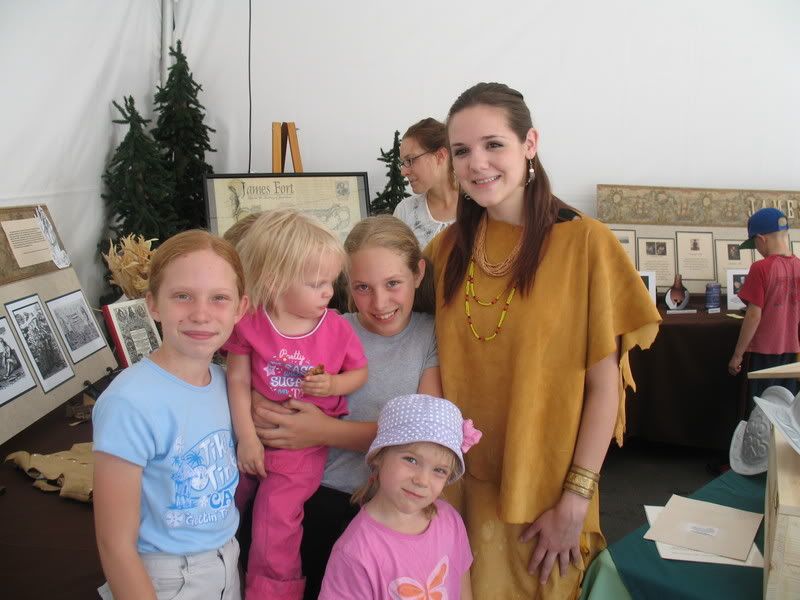
Here is Ben in his Jamestown era hat making a carrot covered face...

This is what the babies loved best (when they were DONE with everything else)
 It was strategically placed for me, because I was within 10 feet of the Pocahontas presentation (which Raymond listened to 3-4 times) and next to the music stage, where Kalani, Natalie and Lydia sat listening to fiddlers and patriotic music.
Friday, June 29, 2007
Les Mis
We saw Les Miserables last night. What an incredible night. I have so many thoughts, it is really a jumble. Of course that could also related to staying up until 2am talking, the getting up with babies at 5.
Random Thoughts:
Marius is so much more likeable in the play, than in the book. He is a strong character with compassion. His love story with Cossette was much more enjoyable because of that.
The differences between America at the time of their revolution and France at the time of its revolution
America-free, independent, self sufficient, educated, moral
France-debt and poverty, immorality
It has been said that a tipping point in cycles of freedom and captivity is when the people vote themselves money...What are tipping points as far as morality go? how about avoiding the consequences and responsibilities of sex?
The Bishop...what a powerful, but brief scene. As he was on stage I was replaying in my head my favorite bishop stories...just so inspiring. I do wish he had been there when Jean Val Jean died. The man palying him has other parts during the play, which also makes it so the Bishop is not in the curtain call.
How amazing it is that Jean Val Jean gets a standing ovation...it just struck me that the actor deserved it, but I wonder how many amazing cycle breaking parents there are who definitely deserve a standing ovation.
Javert..really what was up with that death scene, oh the drama. Everyone else died rather quickly except the leader at the barracade, but even his looked so very mild in comparison. With Javert we have swirling, arm reaching drama...
"Bring Him Home" Jean Val Jean so passionately prays, pleads and begs. How selflessly he prays for another man's life, the man who will take his dear daughter from him. Then after that compassionate moving prayer, he is God's wind, He picks up Marius and struggles through the sewer.
"On my Own" Eponine had the best voice of the night. It was sung so beautifully and honestly. She is also a cycle breaker...a woman who has scarcely been loved, is surroundd by poverty and evil, yet she chooses to love.
I may organize this better later....
Random Thoughts:
Marius is so much more likeable in the play, than in the book. He is a strong character with compassion. His love story with Cossette was much more enjoyable because of that.
The differences between America at the time of their revolution and France at the time of its revolution
America-free, independent, self sufficient, educated, moral
France-debt and poverty, immorality
It has been said that a tipping point in cycles of freedom and captivity is when the people vote themselves money...What are tipping points as far as morality go? how about avoiding the consequences and responsibilities of sex?
The Bishop...what a powerful, but brief scene. As he was on stage I was replaying in my head my favorite bishop stories...just so inspiring. I do wish he had been there when Jean Val Jean died. The man palying him has other parts during the play, which also makes it so the Bishop is not in the curtain call.
How amazing it is that Jean Val Jean gets a standing ovation...it just struck me that the actor deserved it, but I wonder how many amazing cycle breaking parents there are who definitely deserve a standing ovation.
Javert..really what was up with that death scene, oh the drama. Everyone else died rather quickly except the leader at the barracade, but even his looked so very mild in comparison. With Javert we have swirling, arm reaching drama...
"Bring Him Home" Jean Val Jean so passionately prays, pleads and begs. How selflessly he prays for another man's life, the man who will take his dear daughter from him. Then after that compassionate moving prayer, he is God's wind, He picks up Marius and struggles through the sewer.
"On my Own" Eponine had the best voice of the night. It was sung so beautifully and honestly. She is also a cycle breaker...a woman who has scarcely been loved, is surroundd by poverty and evil, yet she chooses to love.
I may organize this better later....
Saturday, June 23, 2007
inspiring teachers
I have had a few wonderful teachers. I was thinking about one a few weeks ago and wrote her a thank you note. It was surprisingly easy to find her on the web and send it to the school where she works. Her name is Sheryl Lloyd. She was my elementary school music teacher. I can still here her voice describing some songs. I will always remember going with her to a jazz club. I can still see her teaching rhythm and hear the sound she makes when she is voicing a drum. It is amazing how strong and impact an inspiring teacher can have.
Mrs. Crie was my 3rd grade teacher. That was a pivotal year for me as we had just moved. New school, new friends...she was fabulous. I can still hear her reading LIttle House on the Prairie. She had the best voice. She was so interesting we all wanted to be good so she could teach.
I was also inspired by my 7th grade algebra teacher. He would make up word problems using our slightly altered names. Our favorite was Miffany Todell. He loved math so much it was intriguing...I couldn't help but look for what there was to love. He made up a series of math problems for us to solve, apply to measurements which would direct us to a certain spot on campus. If we found the right spot, and dug, we found the answers to the math test. He also had this amazing way of making it sound cool to not have been kissed yet, and to wait to date. I don't remember how he did that. Mr. Huyett...what a guy.
My physics teacher was Mr. Harvey. Teaching Physics, the last class of the day, to a bunch of seniors could present a challenge. I don't know of anyone who ever ditched his class. He was fascinating. He loved Physics. He would come in some days and cancel the lecture because he just HAD to share something he just learned. I can still remember one of those spontaneous lectures in my mind. He also had great demonstrations and visuals. I will always remember the endorsement letter her wrote for me. What a guy who took time out for his students.
Not exactly a teacher...but my favorite coach in high school was absolutely Ken Bauman. He loved basketball. He had us diagramming plays and taking the sport seriously. He would get frustrated but had incredible self control. He was such a great example, and so caring. He really got to know us and got us inspired to play because we wanted to play better for him.
After thinking about these teachers it occurred to me...in the course of my public school education I had almost 50 different teachers...and here are 5 that inspired me. I had some other good teachers, and some that were fun...but to me an inspiring teacher is different. An inspiring teacher is passionate about their subject. They are still learning about their subject themselves, because they love it. They share what they learn, because they just can't help it. They inspire me to want to learn on my own. Less than 10% of my teachers fit in that category...
Out of curiosity I polled two message boards...asking how many of their teachers were inspiring. I wasn't implying that the rest of the teachers were bad, but truly inspiring. By far most people replied 3-5 of their teachers were inspiring. Right about what I had and jut under 10 %.. I found this very sad. WHY? Why aren't more teachers inspiring? Is it that they don't get to choose their own curriculum? Is it class size? Is it the principal? Is it how teachers are trained. One person said she didn't think i should expect a majority of teachers to be inspiring...maybe..but not even 15%? One woman (a teacher) said every single one of her teachers was inspiring. She was really a little frustrated with my poll and felt I was attacking teachers. When I asked about her teachers she mentioned things like...oh this teacher had a really pretty bulletin board, this teacher wrote this note to my parents once that made me feel good...ummm perhaps we are inspired by different things.
I can't imagine anything more important in the education of a child, than to have a teacher so excited about learning that they can't help but share. I wonder if it would be different if we changed how we trained teachers. Instead of learning new bulletin board techniques and how to deal with discipline problems; what if we focused on just how fascinating math, English, Reading, Writing, and science can be. What if our teachers left teacher training with a story they can't wait to share about a mathematician, or a science experiment that taught them something new. What if they found a new favorite poem and just couldn't wait to memorize it and recite it for their class. What if they heard a new piece of music, or rediscovered an old artist...how would it change school if our teachers were like that. How can we encourage that?
While you are trying to solve America's education problems, think back on your favorite teachers and write them a note...
Mrs. Crie was my 3rd grade teacher. That was a pivotal year for me as we had just moved. New school, new friends...she was fabulous. I can still hear her reading LIttle House on the Prairie. She had the best voice. She was so interesting we all wanted to be good so she could teach.
I was also inspired by my 7th grade algebra teacher. He would make up word problems using our slightly altered names. Our favorite was Miffany Todell. He loved math so much it was intriguing...I couldn't help but look for what there was to love. He made up a series of math problems for us to solve, apply to measurements which would direct us to a certain spot on campus. If we found the right spot, and dug, we found the answers to the math test. He also had this amazing way of making it sound cool to not have been kissed yet, and to wait to date. I don't remember how he did that. Mr. Huyett...what a guy.
My physics teacher was Mr. Harvey. Teaching Physics, the last class of the day, to a bunch of seniors could present a challenge. I don't know of anyone who ever ditched his class. He was fascinating. He loved Physics. He would come in some days and cancel the lecture because he just HAD to share something he just learned. I can still remember one of those spontaneous lectures in my mind. He also had great demonstrations and visuals. I will always remember the endorsement letter her wrote for me. What a guy who took time out for his students.
Not exactly a teacher...but my favorite coach in high school was absolutely Ken Bauman. He loved basketball. He had us diagramming plays and taking the sport seriously. He would get frustrated but had incredible self control. He was such a great example, and so caring. He really got to know us and got us inspired to play because we wanted to play better for him.
After thinking about these teachers it occurred to me...in the course of my public school education I had almost 50 different teachers...and here are 5 that inspired me. I had some other good teachers, and some that were fun...but to me an inspiring teacher is different. An inspiring teacher is passionate about their subject. They are still learning about their subject themselves, because they love it. They share what they learn, because they just can't help it. They inspire me to want to learn on my own. Less than 10% of my teachers fit in that category...
Out of curiosity I polled two message boards...asking how many of their teachers were inspiring. I wasn't implying that the rest of the teachers were bad, but truly inspiring. By far most people replied 3-5 of their teachers were inspiring. Right about what I had and jut under 10 %.. I found this very sad. WHY? Why aren't more teachers inspiring? Is it that they don't get to choose their own curriculum? Is it class size? Is it the principal? Is it how teachers are trained. One person said she didn't think i should expect a majority of teachers to be inspiring...maybe..but not even 15%? One woman (a teacher) said every single one of her teachers was inspiring. She was really a little frustrated with my poll and felt I was attacking teachers. When I asked about her teachers she mentioned things like...oh this teacher had a really pretty bulletin board, this teacher wrote this note to my parents once that made me feel good...ummm perhaps we are inspired by different things.
I can't imagine anything more important in the education of a child, than to have a teacher so excited about learning that they can't help but share. I wonder if it would be different if we changed how we trained teachers. Instead of learning new bulletin board techniques and how to deal with discipline problems; what if we focused on just how fascinating math, English, Reading, Writing, and science can be. What if our teachers left teacher training with a story they can't wait to share about a mathematician, or a science experiment that taught them something new. What if they found a new favorite poem and just couldn't wait to memorize it and recite it for their class. What if they heard a new piece of music, or rediscovered an old artist...how would it change school if our teachers were like that. How can we encourage that?
While you are trying to solve America's education problems, think back on your favorite teachers and write them a note...
Sunday, May 13, 2007
Manna of motherhood
I was reading about the parting of the Red Sea this morning and thinking about the drama of such a scene. I can't really say I've had that dramatic a miracle in my own life. I have felt miraculous happenings around the birth of my babies and at certain times in my life I have felt the saving influence of the atonement. These are miracles to me. The miracles in my life correlate more closely with the forty years in the wilderness than the dramatic day at the red sea.
I say that because in the daily tasks of motherhood, I have been aided daily by the Savior. I am reminded of a journal entry I made a few months ago...
I am home from church tending my sick babies. Watching Elder Oaks recent conference talk, “He will heal the heavy laden” I am reminded of the help I have received in caring for my children. Elder Oaks said “If your prayers and the power of the priesthood are not enough to heal you of your burden, the atonement of Christ will surely give you the power to bear it”. I have felt that power even in the simple acts of having enough strength to stay awake through the day and take care of my children's’ needs. I was not healed, my children were not instantly healed, yet despite the minuscule amount of sleep I was living on, I was living and functioning enough to mother my children. For me this was a miracle. Perhaps because this miracle is difficult to detect, there was not dry land, where water once stood, or lingering seagulls to notice, I found myself frequently tempted to mentally retain the burden Christ had already physically lightened. I was feeling able to care for my children, but still fearful and lonely in the process. How long would this last? Would I have strength tomorrow? Would I not get much outside help even a person to talk with? My loneliness is real and difficult. For some reason instead of going again to Christ for assistance I would instead use my burden to draw people to me, the very burden which had already been lightened by the Savior! I would mentally take it back. I would talk with people about my struggles with my sick baby and caring for my 6 other young children, all on little sleep and with a husband working diligently and necessarily so, on a new job. Doesn’t that sound impressive? In a way I was bragging for for accomplishing what the Lord was doing , fishing for assistance when it was already being given. I was implying I needed more help than the Lord is giving.
I find it interesting that in the scripture “Come unto me all ye that labor and are heavy laden and I will give you rest. Take my yoke upon you for I am meek and lowly of heart, learn of me and ye shall find rest unto your souls. For my yoke is easy and my burden is light.” I felt I had done the fist part. I recognized that Christ was not going to heal my baby at this time, or somehow lessen my child caring duties, but instead was going to strengthen me to care for my own children. I had found strength and rest in that way. I recognized days when I should have collapsed, but instead had been able to simply care for my children. However, I had not continued by taking his yoke upon me and learning of him. I had accepted the physical support and rest, but not yet the mental and spiritual rest to my soul. That second rest requires additional mental effort-faith and learning. Part of the learning may be to become meek and lowly of heart as the Savior reminds us he is. This humility will keep us from assuming we know better than the Lord how we need to be succored. As if we, the patient, were writing our own prescription and not surprisingly it is a quick easy fix that would no longer necessitate visits to our healer. Hoping to get on with our lives we would avoid the one who gave His life to give us eternal life?
I wonder if this is similar to why the children of Israel grew tired of Manna? That has always fascinated me. I have a good or bad habit of putting myself in the place of the struggling people in the scriptures...perhaps I just identify with them more. I have struggled to understand the children of Israel in their wanderings and miraculous blessings. They were let by a pillar of fire and daily fed by the hand of God, yet they doubted and grumbled. They gathered manna daily and accepted the physical nourishment it gave. Yet they did not seek the aid that would have granted them grace and gratitude amidst their forty year struggle. They continually bucked against gathering daily and became critical of the nurturing food they gathered...it wasn't the kind of help they wanted, nor granted in the way they desired.
Isn't this exactly what I do sometimes? Beg for blessings, than criticize them when they arrive, for being not something enough...the height of ingratitude.
The thing I'm frequently bucking against is not unlike the daily gathering of manna..I sometimes wish for something more than the daily strength I am given. The children of Israel wanted variety in their nourishing gift, and sometimes I do as well. I also notice that I quickly forget to do my daily gathering of scripture study, despite the brightness of the pillar that leads me when I do.
I say that because in the daily tasks of motherhood, I have been aided daily by the Savior. I am reminded of a journal entry I made a few months ago...
I am home from church tending my sick babies. Watching Elder Oaks recent conference talk, “He will heal the heavy laden” I am reminded of the help I have received in caring for my children. Elder Oaks said “If your prayers and the power of the priesthood are not enough to heal you of your burden, the atonement of Christ will surely give you the power to bear it”. I have felt that power even in the simple acts of having enough strength to stay awake through the day and take care of my children's’ needs. I was not healed, my children were not instantly healed, yet despite the minuscule amount of sleep I was living on, I was living and functioning enough to mother my children. For me this was a miracle. Perhaps because this miracle is difficult to detect, there was not dry land, where water once stood, or lingering seagulls to notice, I found myself frequently tempted to mentally retain the burden Christ had already physically lightened. I was feeling able to care for my children, but still fearful and lonely in the process. How long would this last? Would I have strength tomorrow? Would I not get much outside help even a person to talk with? My loneliness is real and difficult. For some reason instead of going again to Christ for assistance I would instead use my burden to draw people to me, the very burden which had already been lightened by the Savior! I would mentally take it back. I would talk with people about my struggles with my sick baby and caring for my 6 other young children, all on little sleep and with a husband working diligently and necessarily so, on a new job. Doesn’t that sound impressive? In a way I was bragging for for accomplishing what the Lord was doing , fishing for assistance when it was already being given. I was implying I needed more help than the Lord is giving.
I find it interesting that in the scripture “Come unto me all ye that labor and are heavy laden and I will give you rest. Take my yoke upon you for I am meek and lowly of heart, learn of me and ye shall find rest unto your souls. For my yoke is easy and my burden is light.” I felt I had done the fist part. I recognized that Christ was not going to heal my baby at this time, or somehow lessen my child caring duties, but instead was going to strengthen me to care for my own children. I had found strength and rest in that way. I recognized days when I should have collapsed, but instead had been able to simply care for my children. However, I had not continued by taking his yoke upon me and learning of him. I had accepted the physical support and rest, but not yet the mental and spiritual rest to my soul. That second rest requires additional mental effort-faith and learning. Part of the learning may be to become meek and lowly of heart as the Savior reminds us he is. This humility will keep us from assuming we know better than the Lord how we need to be succored. As if we, the patient, were writing our own prescription and not surprisingly it is a quick easy fix that would no longer necessitate visits to our healer. Hoping to get on with our lives we would avoid the one who gave His life to give us eternal life?
I wonder if this is similar to why the children of Israel grew tired of Manna? That has always fascinated me. I have a good or bad habit of putting myself in the place of the struggling people in the scriptures...perhaps I just identify with them more. I have struggled to understand the children of Israel in their wanderings and miraculous blessings. They were let by a pillar of fire and daily fed by the hand of God, yet they doubted and grumbled. They gathered manna daily and accepted the physical nourishment it gave. Yet they did not seek the aid that would have granted them grace and gratitude amidst their forty year struggle. They continually bucked against gathering daily and became critical of the nurturing food they gathered...it wasn't the kind of help they wanted, nor granted in the way they desired.
Isn't this exactly what I do sometimes? Beg for blessings, than criticize them when they arrive, for being not something enough...the height of ingratitude.
The thing I'm frequently bucking against is not unlike the daily gathering of manna..I sometimes wish for something more than the daily strength I am given. The children of Israel wanted variety in their nourishing gift, and sometimes I do as well. I also notice that I quickly forget to do my daily gathering of scripture study, despite the brightness of the pillar that leads me when I do.
Friday, May 4, 2007
PBS Mormon Documentary
Well, I watched it. I found the history fairly well done. Obviously polygamy needs to be discussed. Obviously the Mountain Meadows Massacre should be discussed, it is a truly tragic event.
I will never understand why the best source of information would be an excommunicated member. One woman tells in detail how she was excommunicated for teaching doctrines that contradict church teachings...yet she is quoted explaining church doctrine and the most sacred experiences available to church members. A man explains that his excommunication ended his marriage...is he really sure that it wasn't the homosexual affair he had? Would his wife had been fine with that, if he hadn't been excommunicated?
I was most mystified by the dancing comment...Mormons value dancing above education. Where in the world was that from?
I would have loved to see the docuentarian use our artwork, or at least more neutral artwork. A very dark picture of Jesus in reds and blacks, with music in a minor key....this is the background for Joseph Smith's first vision? The wording of the vision was fairly accurate, so why the slant on the art?
My favorite part of the whole documentary was an Evangelical minister. He obviously does not believe what I believe, yet he was very respectful. Wonderful!
Perhaps it could have been called Perspectives on Mormonism...it did show different perspectives.
I will never understand why the best source of information would be an excommunicated member. One woman tells in detail how she was excommunicated for teaching doctrines that contradict church teachings...yet she is quoted explaining church doctrine and the most sacred experiences available to church members. A man explains that his excommunication ended his marriage...is he really sure that it wasn't the homosexual affair he had? Would his wife had been fine with that, if he hadn't been excommunicated?
I was most mystified by the dancing comment...Mormons value dancing above education. Where in the world was that from?
I would have loved to see the docuentarian use our artwork, or at least more neutral artwork. A very dark picture of Jesus in reds and blacks, with music in a minor key....this is the background for Joseph Smith's first vision? The wording of the vision was fairly accurate, so why the slant on the art?
My favorite part of the whole documentary was an Evangelical minister. He obviously does not believe what I believe, yet he was very respectful. Wonderful!
Perhaps it could have been called Perspectives on Mormonism...it did show different perspectives.
Wednesday, April 25, 2007
a day in the life...a very random day at that
I wake up shortly before 6, check my email and start to exercise. My dear son Raymond wakes up and the questions begin. My favorite question during exercise..."Mom why are you still exercising, your stomach is just like it was before the babies" He then runs away and doesn't understand why I am trying to kiss him.
We actually read our scriptures to relative quiet...assuming car and pony noises are "relatively" quiet.
I feed everyone breakfast while Chris takes off to work.
I sneak in a shower...the babies come and find me.
Ben the 3 year old decides that he prefers the living room floor to the toilet or the diaper...I think I need another shower.
Raymond greets me with the question...how many keys are there on a flute. I wish desparately our computer were back from the shop so I could google. How did parents deal with curious children without google? I call BYU info, figuring their computer department has my computer for a rediculously long time, maybe they can work for me...naw. I all a musical neighbor and she googles it, but we are still in discussion. How about the holes that are not necessarily keys? I try to distract Raymond with discussion of Piano's being a string instrument while the organ is a wind intrument...he doesn't get distracted easily.
Snack time...ants on a log. Raymond asks...is the peanut butter the log, or the celery?
We are reading Summer of the Monkeys. In this particular section Jimbo the Chimpanzee gets the boy drunk...he feels disgustingly sick. We look up the words sober, chimpanzee and hydrophobia (did you know Rabies is sometimes called hydrophobia because the animals get so sick the stop wanting to drink?)
Raymond interupts our reading to ask about the difference between a mule and a donkey...
LUNCH and chores (surprisingly painless)and NAPS!
The children watch a short show while I read...Those who love by Irving Stone. It is a fascinating book about Abigail and John Adams. It stimulates a thought..In around 1785 there were about 6000 abandoned babies a year in Paris. How does that happen? At a lecture I attended they suggested a tipping point in government is when the people vote themselves money. I wonder what some tipping points in morality are? I also wonder again at the differences between the American revolution and the French Revolution. I discover that Ben tried to use the whole bottle of soap to wash his hands, and his belly and legs and the chair. Miraculously his face is still very dirty. I throw him in the shower...he screams because he has hydrophobia...or because he'd rather not take a shower.
The babies wake up and all deep thought is drowned out by crying. We all go outside and enjoy the beautiful day.
Dinner is later than expected, which is normal. It is also vastly underappretiated.
I get all the children to bed, except Becca who is having personal difficulties in that area.
Natalie snuggles our cat fuzzy while I read to her for her night.
Chris comes homes and devours the dinner, then changes and runs out to play basketball.
QUIET!! I do dishes and here I sit...ahhh
Now I can google all those questions, as well as the word for the day from yesterday in a black hole video "spagetification"???
We actually read our scriptures to relative quiet...assuming car and pony noises are "relatively" quiet.
I feed everyone breakfast while Chris takes off to work.
I sneak in a shower...the babies come and find me.
Ben the 3 year old decides that he prefers the living room floor to the toilet or the diaper...I think I need another shower.
Raymond greets me with the question...how many keys are there on a flute. I wish desparately our computer were back from the shop so I could google. How did parents deal with curious children without google? I call BYU info, figuring their computer department has my computer for a rediculously long time, maybe they can work for me...naw. I all a musical neighbor and she googles it, but we are still in discussion. How about the holes that are not necessarily keys? I try to distract Raymond with discussion of Piano's being a string instrument while the organ is a wind intrument...he doesn't get distracted easily.
Snack time...ants on a log. Raymond asks...is the peanut butter the log, or the celery?
We are reading Summer of the Monkeys. In this particular section Jimbo the Chimpanzee gets the boy drunk...he feels disgustingly sick. We look up the words sober, chimpanzee and hydrophobia (did you know Rabies is sometimes called hydrophobia because the animals get so sick the stop wanting to drink?)
Raymond interupts our reading to ask about the difference between a mule and a donkey...
LUNCH and chores (surprisingly painless)and NAPS!
The children watch a short show while I read...Those who love by Irving Stone. It is a fascinating book about Abigail and John Adams. It stimulates a thought..In around 1785 there were about 6000 abandoned babies a year in Paris. How does that happen? At a lecture I attended they suggested a tipping point in government is when the people vote themselves money. I wonder what some tipping points in morality are? I also wonder again at the differences between the American revolution and the French Revolution. I discover that Ben tried to use the whole bottle of soap to wash his hands, and his belly and legs and the chair. Miraculously his face is still very dirty. I throw him in the shower...he screams because he has hydrophobia...or because he'd rather not take a shower.
The babies wake up and all deep thought is drowned out by crying. We all go outside and enjoy the beautiful day.
Dinner is later than expected, which is normal. It is also vastly underappretiated.
I get all the children to bed, except Becca who is having personal difficulties in that area.
Natalie snuggles our cat fuzzy while I read to her for her night.
Chris comes homes and devours the dinner, then changes and runs out to play basketball.
QUIET!! I do dishes and here I sit...ahhh
Now I can google all those questions, as well as the word for the day from yesterday in a black hole video "spagetification"???
Subscribe to:
Posts (Atom)
